When research receives public backlash, how do we support researchers?
To celebrate PEP Week, the team behind 'Is all publicity good publicity? Addressing Public Harassment in LGBT+ Research Impact & Engagement' share the new practical resources they have created to help public engagement professionals navigate the challenges of communicating research on politically contested or highly scrutinised topics.
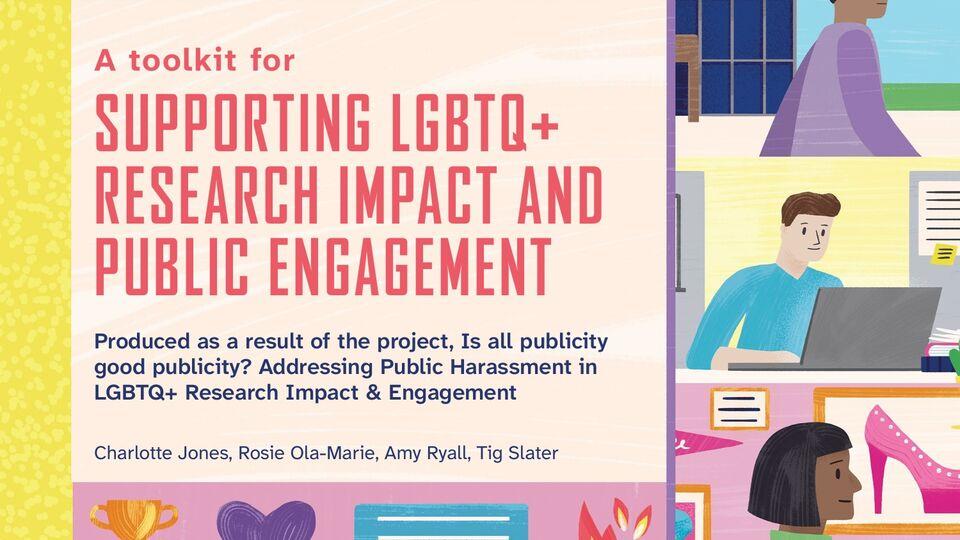
For research to reach wider publics and create meaningful impact, researchers need to be supported to communicate their work safely. Those supporting researchers also need the knowledge, resources and institutional backing to prepare and respond effectively. Our new report, Is all publicity good publicity?, details some of the challenges faced by public engagement professionals when supporting research on LGBTQ+ topics, and provides recommendations for addressing the issues raised by this work.
In an increasingly transphobic and queerphobic environment, public engagement, knowledge exchange and impact work is more difficult and unsafe for researchers working on LGBTQ+ topics. Respondents in our study reported experiencing backlash from people seeking to discredit their work as well as personal attacks. For some, these experiences led to decisions to withdraw from public-facing work, limit how they share their research, or consider leaving their career altogether.
Central to good research dissemination are the professional research support staff who help researchers share their work with wider publics. Our research found that public engagement professionals are often on the front line of supporting researchers, yet institutional policies and processes do not always provide adequate training, guidance or resources to navigate the potential challenges. Under these circumstances, professional services staff face a difficult tension between encouraging public-facing work while knowing that this engagement can expose researchers to harms that are not adequately mitigated.
“...if a university is funding or is hosting research…that is about LGBTQ concerns or issues…there is a responsibility of care on the university for those researchers, but I just don’t see it really enacted regularly. I think if a university is willing to host research, they should be willing to protect the researchers and to protect the researchers’ wellbeing…”
(Quinn, Communications Officer
By mapping the current landscape of LGBTQ+ research-related abuse, we hoped to develop strategies for mitigating risk and supporting researchers, and identify examples of good practice. With both researchers and public engagement professionals in mind, our report provides practical, sector-wide, solutions for those on the ground, whilst also advocating for and encouraging institutional and structural change. Key to this is alleviating pressure on public engagement professionals. Our research found that many people in this role are committed to supporting researchers, often going above and beyond to help navigate these challenges. However, institutions should not rely on the individual efforts of often junior and overworked staff as a substitute for developing more robust structures, resources and support systems. An institutional and sectoral response is essential if research, public engagement and impact are to happen well.
Full recommendations can be accessed in our report, but a few examples include:
- Clear, formal policies, pathways and procedures - staff should know who to approach and how a situation will be dealt with, in advance of it happening
- Public institutional support - institutions should be prepared to make public statements, supporting researchers to mitigate harassment
- Guidance and support from funding bodies, including conditions of funding which insist on institutional policies and procedures
- Mechanisms to support reporting abuse
- Research impact training that addresses challenging contexts.
To support training and the implementation of these recommendations, we also produced a toolkit comprising a flexible collection of resources and activities to support professional services staff. It can be used in a variety of contexts, including training sessions, individual reflection, discussions with line managers or the development of internal support mechanisms.
The toolkit can be accessed via our webpage.
Public engagement professionals play a crucial role in creating the conditions for meaningful research leading to social change. Our toolkit and report aim to strengthen the support structures needed for researchers to share their work safely, while ensuring those supporting this engagement are equipped to navigate any challenges that might arise.
Credits
Written by Amy Ryall (The Royal Central School of Speech and Drama), Rosie Ola-Marie (University of Bristol), Charlotte Jones (Swansea University) and Tig Slater (Sheffield Hallam University)