Home

Main navigation

  • Exploring Engagement
    • Introducing Public Engagement
    • Quality Practice
    • Evaluation
    • Partnership Working
    • Strategy and Leadership
    • Policy and Funding
  • Our services
    • Manifesto
    • Training
    • Engage Watermark
    • Consultancy
    • Engage Fellowships
    • Engage Academy
    • Engage Events
    • REF 2029
  • What's happening?
    • News
    • Blog
    • Our projects
    • Funding Opportunities
    • Engage Events
    • Engaged Futures
    • REF 2029
    • Seminar Series
  • Learn from others
    • Watermark Awardees
    • Manifesto Signatories
    • Connect and Network
    • Case Studies
    • Engage Fellows
    • Convening Knowledges
    • Research for All
  • Resources
  • About us
    • Vision and mission
    • Who we are
    • Equity, Diversity and Inclusion (EDI)
    • Contact us
Menu Close Search Close

Main navigation

  • Exploring Engagement
    • Introducing Public Engagement
    • Quality Practice
    • Evaluation
    • Partnership Working
    • Strategy and Leadership
    • Policy and Funding
  • Our services
    • Manifesto
    • Training
    • Engage Watermark
    • Consultancy
    • Engage Fellowships
    • Engage Academy
    • Engage Events
    • REF 2029
  • What's happening?
    • News
    • Blog
    • Our projects
    • Funding Opportunities
    • Engage Events
    • Engaged Futures
    • REF 2029
    • Seminar Series
  • Learn from others
    • Watermark Awardees
    • Manifesto Signatories
    • Connect and Network
    • Case Studies
    • Engage Fellows
    • Convening Knowledges
    • Research for All
  • Resources
  • About us
    • Vision and mission
    • Who we are
    • Equity, Diversity and Inclusion (EDI)
    • Contact us
Contact Us

Suggested search items

Engaged Futures
Equity and Inclusion
REF collection
Blog
Case Studies
Engage Summit 2026

Breadcrumb

  1. Home
  2. Resources
  3. Shielding Change Agents: An Institutional Protection Protocol
Racial Equity Resources

Shielding Change Agents: An Institutional Protection Protocol

Opens in a new window Opens in a new window
Copied to clipboard
on this page
  1. Institutional duty of care
  2. The Four pillars of trauma-informed public engagement
  3. Three-phase incident and backlash protocol

Purpose: Activates mandatory institutional protection mechanisms across three operational phases—before public exposure, during active backlash, and post-incident recovery. It shifts the burden from individual "resilience" to an enforceable institutional duty of care and collective protection framework.

updated on 27 Oct 2026
Estimated reading time: 20 minutes
4 minutes read

Institutional duty of care

When public engagement moves beyond performative diversity toward systemic power-sharing and anti-racist critique, public visibility becomes a primary site of institutional and personal risk. Online hate, media storms, doxxing, and coordinated harassment fall disproportionately on minoritised practitioners, precariously employed staff, women, disabled, and LGBTQIA+ workers who absorb public hostility alongside institutional isolation.

Institutions extract significant reputational currency and research funding from public-facing equity work. To fulfil statutory obligations under Health & Safety (H&S) legislation and the Equality Act 2010, universities must treat digital hate and public backlash as formal workplace hazards—not personal problems.

Recognised workload tariff framework (Yelin & Clancy Model)

Racial equity leadership and crisis navigation cannot be treated as voluntary "citizenship" or unpaid emotional labour. Line managers must allocate explicit annual WAM hours under formal promotion and appraisal criteria:
  • Leading High-Risk Equity Projects (50–100 hours/year): Covers anti-racist project design, community partnership management, and public-facing risk navigation. Formally recognised in annual appraisals and promotion rounds.
  • Crisis Management & Backlash Navigation (30–50 hours/year): Allocated during active media storms, doxxing, or harassment to manage safety protocols and institutional triage.
  • Mentoring Minoritised Staff & Students (20–30 hours/year): Formally accounts for pastoral care and institutional navigation, preventing uncompensated informal labour.
  • Equity Governance & Policy Drafting (20–40 hours/year): Covers committee interventions, legal contract negotiations, and institutional  advocacy.

Before launching a high-visibility project, reflect:

  • Is your racial equity or community crisis work explicitly tariffed in your annual Workload Allocation Model (WAM), or is it expected as uncompensated "citizenship" labour?
     
  • Who in your project team carries the highest public visibility, and are they protected by permanent contracts or exposed by precarious/temporary employment?
     
  • Does your department treat digital harassment as a formal Health & Safety incident requiring line management action, or as an individual's private social media issue?

The Four pillars of trauma-informed public engagement

Trauma-informed practice ensures racial equity work remains operationally sustainable over long timelines without extracting practitioners' or community partners' health and well-being.

Review your current engagement design against the four pillars below:

  • Have you held a clear, "no-surprises" discussion with community partners and junior staff about potential public pushback before public launch?
     
  • Is post-event debriefing built into your official project timeline as paid working hours, or do staff disperse immediately after high-friction sessions without processing?
     
  • Do you schedule post-event recovery time into your grant milestones, or do staff treat rest as something they must squeeze into their personal weekends?

1. Safety and transparency

Clear, non-surprising communication regarding project expectations, risks, and institutional backing before work begins.

2. Humility and shared power

Rejecting top-down institutional authority; valuing lived experience alongside academic research.

3. Peer support and debriefing

Normalising post-event debriefs, informal peer support, and collective processing after high-friction sessions.

4. Mandatory rest and recovery

Treating rest as an essential workplace right, not an optional luxury.

Three-phase incident and backlash protocol

This protocol activates mandatory institutional protection mechanisms across three operational phases: before public exposure, during active backlash, and post-event recovery.
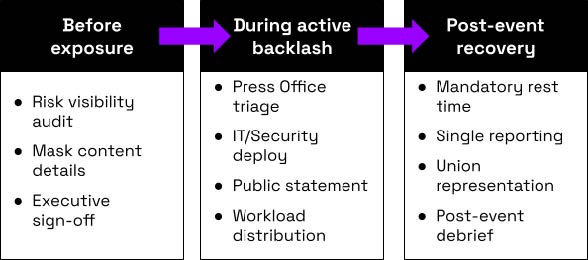
Diagram showing the mandatory institutional protection mechanisms across each of the three operational phases: before public exposure, during active backlash and post-event recovery. You can see more detail on each mechanism below.

Phase 1: Pre-emptive protection

  1. Public visibility risk audit: Before launching public-facing anti-racist campaigns or releasing research on contested histories, the project team and department head must audit the likelihood of external pushback and activate protective protocols in advance.
     
  2. Contact detail masking: Direct personal phone numbers, office locations, and individual email addresses must never be published on university project pages or press releases. Route all communications through generic, team-monitored departmental inboxes.
     
  3. Executive pre-approval and binding support: The team must secure written sign-off from senior leadership explicitly committing to maintain institutional backing and keep project materials online if external or media pushback occurs.

Phase 2: Crisis intervention

  1. First-line media triage firewall: The University Communications & Press Office must act as a compulsory shield. Redirect all media inquiries, journalist calls, and social media comments to the Press Office. Practitioners are strictly instructed not to field direct press inquiries.
     
  2. IT and campus security deployment: University IT Services must immediately apply emergency spam filtering, track cyber-harassment vectors, and coordinate with Campus Security if physical or geographic safety risks arise.
     
  3. Institutional public statement protocol: The university must issue an immediate public statement affirming its support for the staff member/project and condemning targeted harassment. The institution must not remain silent or quietly remove project webpages under pressure.
     
  4. Immediate workload relief: Line managers, in agreement with the practitioner, must immediately reassign non-essential tasks to give the practitioner the operational space required to manage safety protocols and personal well-being.

Phase 3: Post-event recovery and institutional accountability

  1. Mandatory post-event recovery time: Line managers must grant practitioners formal, protected recovery time (at least a half-day) following high-friction events or media storms to rest and reset.
     
  2. Single-documentation policy: To prevent re-traumatisation, practitioners who experience racial abuse or public harassment must never be forced to repeat their account to multiple committees or managers. Log incident details once in a centralised, confidential file managed by a designated lead.
     
  3. Trade union & casework insulation: Staff experiencing targeted digital hate, institutional harassment, or threats to employment security should immediately engage local trade union representatives or seek legal advice, casework support, and formal representation.

Where next

Racial Equity Resources

Words Matter: A Language Guide for Centring Racial Equity

The words we choose when discussing racial equity matter. The language we use shapes what we can see, name, and discuss. Words only matter when they change what we do [...]
Racial Equity Resources

Overcoming Delay: A Live Negotiation Manual for Institutional Pushback

Purpose: Provide change agents, engagement leads, and equity practitioners with strategic scripts and structural governance levers to dismantle institutional excuses, administrative delay tactics, epistemic gatekeeping, and executive panic. When public [...]

Contact us

Want to discuss a new idea, ask a question or provide some feedback? Get in touch with the team.
Contact us

Join our community

NCCPE's Public Engagement Professional Network is for those doing or supporting public and community engagement.
Find out more!

NCCPE Services

We help universities to better support, embed and recognise meaningful public engagement.
Explore our services

Sign up to our newsletter

Subscribe to our mailing list to receive the latest engagement news, events and opportunities from the NCCPE.

Please see our privacy notice for information on how your data will be processed.

Sign up
University of the West of England: logo
University of Bristol logo
Home

Copyright 2026 National Co-ordinating Centre for Public Engagement
Funded by UK Research and Innovation, the devolved Higher Education funding bodies, and Wellcome

Website by Big Blue Door

Utilities

  • Privacy Policy
  • Accessibility
  • Cookie Policy