Home

Main navigation

  • Exploring Engagement
    • Introducing Public Engagement
    • Quality Practice
    • Evaluation
    • Partnership Working
    • Strategy and Leadership
    • Policy and Funding
  • Our services
    • Manifesto
    • Training
    • Engage Watermark
    • Consultancy
    • Engage Fellowships
    • Engage Academy
    • Engage Events
    • REF 2029
  • What's happening?
    • News
    • Blog
    • Our projects
    • Funding Opportunities
    • Engage Events
    • Engaged Futures
    • REF 2029
    • Seminar Series
  • Learn from others
    • Watermark Awardees
    • Manifesto Signatories
    • Connect and Network
    • Case Studies
    • Engage Fellows
    • Convening Knowledges
    • Research for All
  • Resources
  • About us
    • Vision and mission
    • Who we are
    • Equity, Diversity and Inclusion (EDI)
    • Contact us
Menu Close Search Close

Main navigation

  • Exploring Engagement
    • Introducing Public Engagement
    • Quality Practice
    • Evaluation
    • Partnership Working
    • Strategy and Leadership
    • Policy and Funding
  • Our services
    • Manifesto
    • Training
    • Engage Watermark
    • Consultancy
    • Engage Fellowships
    • Engage Academy
    • Engage Events
    • REF 2029
  • What's happening?
    • News
    • Blog
    • Our projects
    • Funding Opportunities
    • Engage Events
    • Engaged Futures
    • REF 2029
    • Seminar Series
  • Learn from others
    • Watermark Awardees
    • Manifesto Signatories
    • Connect and Network
    • Case Studies
    • Engage Fellows
    • Convening Knowledges
    • Research for All
  • Resources
  • About us
    • Vision and mission
    • Who we are
    • Equity, Diversity and Inclusion (EDI)
    • Contact us
Contact Us

Suggested search items

Engaged Futures
Equity and Inclusion
REF collection
Blog
Case Studies
Engage Summit 2026

Breadcrumb

  1. Home
  2. Resources
  3. Words Matter: A Language Guide For Centring Racial Equity
Racial Equity Resources

Words Matter: A Language Guide for Centring Racial Equity

Opens in a new window Opens in a new window
Copied to clipboard
on this page
  1. Terms we intentionally select and how to use them
  2. Terms we intentionally avoid and why
  3. Racially equitable alternatives to common institutional phrasing
  4. Reflect on your practice

Please note: This page is currently in development. The content is in draft form and may change before the resource is formally launched.

Exploring how the words we choose shape what we notice, how we share power, and how we relate to one another.

The words we use when talking about racial equity matter. The language we use determines what we can see, what we can name and what we can talk about. Words only matter when they change what we do.

In public engagement and higher education, the words we use shape how we understand power, who we hold responsible, and whether we treat the public, partners, and staff as equals. Using vague, deficit-based*, or oppressive language can hide institutional racism and mask real power imbalances.

This guide describes the language choices used throughout this resource and applies to both written and spoken communication. It supports you and your team in communicating more clearly, whether you are preparing written materials, writing funding bids, or speaking with colleagues, partners, and communities.
RETURN TO RACIAL EQUITY RESOURCE HOMEPAGE

updated on 13 Nov 2026
Estimated reading time: 10 minutes
9 minutes read
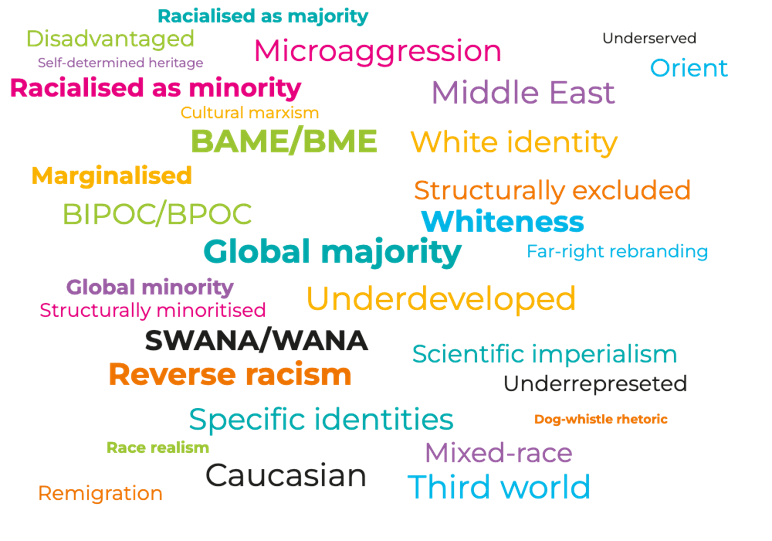
Word cloud showing various terms such as microagression, underserved, BAME/BME, remigration, third world etc.

When you think about your use of language:

  • Be explicit and direct: Use words that clearly state who is involved or what is happening, rather than vague or passive terms.
     
  • Respect people's choices: When working with individuals and communities, always use the names, the descriptors and the heritage terms that they themselves prefer.
     
  • Language changes over time: Treat language as a tool for connecting, learning, and building trust. Accept feedback when you make mistakes.
     
  • Translation and interpretation: Racially equitable language includes making space for multilingual interpretation and enabling people to share and report in the languages they are most comfortable with.

Terms we intentionally select and how to use them

Excluded (or systemically excluded, historically excluded)

What it means: Describes individuals, communities, and forms of knowledge that institutional processes, funding models, and governance structures have actively kept out.

Why we use it: It directly challenges deficit* labels like "hard-to-reach" or "disengaged," which subtly blame communities for their absence. It puts accountability back on institutions, making clear that missing voices result from institutional barriers we have a responsibility to dismantle.

Global majority

What it means: Refers to Black, Asian, Brown, Indigenous, dual-heritage, and those not racialised as white who represent over 80% of the world’s population.

Why we use it: It fundamentally reframes the narrative. In the UK, racialised communities are frequently referred to as “minorities”. Centring the term Global Majority replaces isolation or marginality with global presence and demographic reality.

The appropriate terminology in the UK should be “people from global majority backgrounds who are racialised as minorities in the UK”. We agree that it can indeed be quite a mouthful. To streamline it while maintaining clarity, we use simpler phrases in the resource, such as "global majority communities" or "racialised minority communities in the UK". 

Racialised as minority / Racialised as majority

What it means: Race is not a biological fact; it is a social and historical process. Racialisation describes how society assigns racial categories, meanings, and power levels to different groups.

Why we use it: Everyone is racialised—including white people. Describing someone as "racialised as a majority" makes visible the privileges and default norms attached to Whiteness in UK institutions. Describing someone as "racialised as a minority" highlights that their racial status is something imposed by external systems rather than a personal trait.

In verbal presentations or panel discussions, say “majority white institutions/groups” or “groups racialised as the majority” to avoid confusion with “racialised minority”.

Self-determined heritage and specific identities

What it means: Using self-chosen and specific terms when referring to individuals or distinct communities (e.g., Somaliland community, British-Pakistani heritage, Afro-Caribbean diaspora).

Why we use it: It acknowledges broad cultural, linguistic, and historical differences. In public engagement, specificity ensures activities respond to lived experiences rather than generalised stereotypes.

Whiteness and white identity

What it means: Explicitly naming whiteness as a racial identity rather than treating it as the invisible, default norm.

Why we use it: When whiteness remains unnamed, people treat white perspectives as “neutral,” “objective,” or “universal,” while marking all other perspectives as “diverse” or “other.” Naming whiteness allows us to examine white normativity and privilege in research and public engagement.

Common everyday language

What it means: Clear, everyday language that avoids unnecessary academic jargon and institutional buzzwords.

Why we use it: Theoretical jargon around race can create barriers for non-specialists. Plain language ensures racial equity conversations remain accessible, actionable, and usable for everyone.

Minoritised

What it means: Using minoritised as a verb or adjective (e.g., “minoritised communities” or “minoritised groups”) shows that institutional structures, policies, and power relationships have actively pushed groups into minority status.

Why we use it: Unlike the static noun “minority,” minoritised explicitly addresses the action of external systems and institutions. It shifts the focus from “who people are” to “what is being done to them.”

Terms we intentionally avoid and why

BAME / BME (Black, Asian, and Minority Ethnic)

Why we avoid it: These acronyms collapse wildly diverse populations into a single monolithic bucket. They mask specific inequalities, such as anti-Blackness or anti-Muslim racism, and allow institutions to claim “diversity success” while failing to address differences in structural inequalities.

What we use instead: Global majority, racially minoritised or specific heritage descriptors.

BIPOC / BPOC (Black, Indigenous, and People of Colour)

Why we avoid it in the UK context: While BIPOC originated in the United States to highlight specific histories of Native American displacement and African enslavement, importing it uncritically into the UK misaligns with British colonial, imperial, and immigration histories. 

What we use instead: Global Majority or racialised minority groups.

Caucasian

Why we avoid it: Caucasian comes from an old, false idea from the 1700s that people from the Caucasus region were the “perfect” example of humans. This term was used to support racist beliefs that some groups of people were better than others based on biology. Unlike terms that reflect someone’s real background or culture, “Caucasian” has no real cultural or linguistic meaning today.

What we use instead: White or racialised majority.

Colonial language and scientific imperialism

Why we avoid it: Expressions like “Discover,” “Pioneer,” “Frontier,” “Uncharted territory,” or framing academic spaces as “Professional” versus community spaces as “Savage” draw directly on colonial tropes. As Ursula K. Le Guin’s Carrier Bag Theory and Ebony Elizabeth Thomas’s concepts of Endarkenment show, standard narratives usually glorify extractive “heroic discovery” while casting global majority knowledge as archaic or nonexistent.

What we use instead: Partner, learn alongside, co-create.

Colonial region naming / Third World / Orient / Underdeveloped / Middle East

Why we avoid it: Terms like "Third World" and "Underdeveloped" impose hierarchical, deficit-based* classifications rooted in Cold War politics and economic paternalism. Geographic terms like "Middle East" or "Orient" are Eurocentric—they define regions purely by their spatial relationship to Western Europe. These labels collapse distinct sovereign nations, cultural histories, and languages into monolithic, exoticised, or subordinate categories.

What we use instead: Use specific country or regional names (e.g., Somaliland, South Asia), or geography-centred acronyms like SWANA (Southwest Asia and North Africa) or WANA (West Asia and North Africa). When discussing global economic disparities, use Global South / Global North while acknowledging their limitations.

Far-right rebranding and dog-whistle rhetoric

Why we avoid it: Be vigilant against bad-faith framing and dog-whistle politics (e.g., “remigration,” “cultural Marxism”, “race realism” or weaponised claims of “reverse racism” when racial equity measures are introduced). These terms are designed to rebrand racial hostility as legitimate political discourse (e.g. “Remigration” is nothing else than ethnic cleansing).

What we use instead: Name these tactics clearly as bad-faith pushback, racial harassment, or structural resistance*.

Marginalised / Disadvantaged

Why we avoid it: These terms act as passive labels that describe a state of being without identifying the cause. They make it sound as though a community spontaneously exists in a state of marginality.

What we use instead: Structurally excluded or systemically minoritised.

Microaggression

Why we avoid it: The word "micro" makes these acts sound small, minor, or harmless - but they're not. Being constantly targeted by subtle racial put-downs, exclusions, and insults builds up over time. This steady build-up causes real mental, emotional, and physical harm, leading to chronic stress, anxiety, and burnout. Calling this harm "micro" makes it too easy for people and institutions to dismiss these incidents as small, one-off mistakes rather than recognising them as part of everyday structural racism.

What we use instead: Everyday racial harm, subtle racial attacks, racial violence, or everyday racism.

Mixed / Mixed-race

Why we avoid it: The phrase "mixed race" can suggest that "races" are fixed, biological categories, rather than social and historical constructs. Some people find "mixed" or "mixed-race" limiting or even offensive, while others may choose these words for themselves. Using broad terms like "mixed" can also hide the rich cultural, national, and ethnic backgrounds that shape each person's experience, such as South Asian and white, or Indigenous heritages. Multiracial people are often seen only through the lens of how they look or who they are assumed to resemble, which can create identity challenges and overlook the specific biases and barriers they may face.

What we use instead: We use "people of mixed heritage," "people of mixed background," or "multiracial." Whenever possible, we name specific heritages directly, such as "students of Black Caribbean and white heritage." This approach respects each person's unique background and avoids reducing anyone to a single, broad label.

Underserved / Underrepresented

Why we avoid it: Without context, these terms carry a deficit-based* implication, suggesting the problem lies with communities who “fail to engage” or “lack interest” in science and research.

What we use instead: Be clear about institutional responsibility, for example, by saying “communities our institution has historically excluded or failed to build trust with.” While institutions often use "underserved" as a deficit* label, some community groups may use it themselves to advocate for resources or recognition. Whenever possible, use the terms your local community partners prefer.

Racially equitable alternatives to common institutional phrasing

The table below shows how common institutional phrasing can be transformed into racially equitable language.

Standard institutional phrase
Racially equitable alternative
Why it matters
Standard institutional phrasing: “We want to target BAME audiences in hard-to-reach communities.”
Racially equitable alternative: “We want to build long-term partnerships together with local British-Pakistani community groups who have been historically excluded from our campus.”
It matters because it replaces a monolithic acronym with specificity; shifts the flaw from “hard-to-reach” communities to institutional barriers.
Standard institutional phrasing: “This project aims to boost science capital in BIPOC underserved youth.”
Racially equitable alternative: “This project resources racialised minority youth to explore research questions that matter to their lives using community knowledge and scientific tools.”
It matters because it moves away from deficit* framing (“fixing missing capital”) toward asset-based* co-creation and community empowerment.
Standard institutional phrasing: “We need a diverse panel to ensure BME representation.”
Racially equitable alternative: “We are inviting researchers and community practitioners racialised as minorities who hold expertise in environmental justice.”
It matters because it prevents tokenism and values individuals for their specific expertise and lived experience, rather than as racial quota fillers.
Standard institutional phrasing: “Participants showed a lack of engagement with the festival exhibits.”
Racially equitable alternative: “The festival's lack of multilingual interpretation created institutional barriers for visiting families.”
It matters because it places responsibility on the institutional space and design rather than blaming visitors.

Reflect on your practice

Use these questions to analyse how language is used across your project, team and organisation:

Reflection 1

Are you using words like "marginalised" or "underrepresented," or are you clearly naming structural barriers and institutional responsibilities?

Reflection 2

Have you invited your partners to share how they would like to be described, using their own words and preferences instead of defaulting to institutional acronyms or labels?

Reflection 3

When choosing words for your project title, funding bid, or outreach, are there opportunities to move away from colonial metaphors like "discovery," "pioneering," or "mapping uncharted territory"? How might you reframe your language to centre care, reciprocity, and mutual learning?

Reflection 4

Does your proposal create space for community partners to have real decision-making power over budgets, or are they limited to advisory roles while funding remains within university accounts?

Where next

Racial Equity Resources

Glossary

This glossary is here to support you as you explore terms and ideas connected to racial equity and institutional culture in higher education. As the world changes, so does our [...]
Racial Equity Resources

Mapping Your Power: A 35-minute Reflective Audit for Practitioners

Please note: This page is currently in development. The content is in draft form and may change before the resource is formally launched. Reflecting on how your personal experiences, professional [...]

Contact us

Want to discuss a new idea, ask a question or provide some feedback? Get in touch with the team.
Contact us

Join our community

NCCPE's Public Engagement Professional Network is for those doing or supporting public and community engagement.
Find out more!

NCCPE Services

We help universities to better support, embed and recognise meaningful public engagement.
Explore our services

Sign up to our newsletter

Subscribe to our mailing list to receive the latest engagement news, events and opportunities from the NCCPE.

Please see our privacy notice for information on how your data will be processed.

Sign up
University of the West of England: logo
University of Bristol logo
Home

Copyright 2026 National Co-ordinating Centre for Public Engagement
Funded by UK Research and Innovation, the devolved Higher Education funding bodies, and Wellcome

Website by Big Blue Door

Utilities

  • Privacy Policy
  • Accessibility
  • Cookie Policy