Home

Main navigation

  • Exploring Engagement
    • Introducing Public Engagement
    • Quality Practice
    • Evaluation
    • Partnership Working
    • Strategy and Leadership
    • Policy and Funding
  • Our services
    • Manifesto
    • Training
    • Engage Watermark
    • Consultancy
    • Engage Fellowships
    • Engage Academy
    • Engage Events
    • REF 2029
  • What's happening?
    • News
    • Blog
    • Our projects
    • Funding Opportunities
    • Engage Events
    • Engaged Futures
    • REF 2029
    • Seminar Series
  • Learn from others
    • Watermark Awardees
    • Manifesto Signatories
    • Connect and Network
    • Case Studies
    • Engage Fellows
    • Convening Knowledges
    • Research for All
  • Resources
  • About us
    • Vision and mission
    • Who we are
    • Equity, Diversity and Inclusion (EDI)
    • Contact us
Menu Close Search Close

Main navigation

  • Exploring Engagement
    • Introducing Public Engagement
    • Quality Practice
    • Evaluation
    • Partnership Working
    • Strategy and Leadership
    • Policy and Funding
  • Our services
    • Manifesto
    • Training
    • Engage Watermark
    • Consultancy
    • Engage Fellowships
    • Engage Academy
    • Engage Events
    • REF 2029
  • What's happening?
    • News
    • Blog
    • Our projects
    • Funding Opportunities
    • Engage Events
    • Engaged Futures
    • REF 2029
    • Seminar Series
  • Learn from others
    • Watermark Awardees
    • Manifesto Signatories
    • Connect and Network
    • Case Studies
    • Engage Fellows
    • Convening Knowledges
    • Research for All
  • Resources
  • About us
    • Vision and mission
    • Who we are
    • Equity, Diversity and Inclusion (EDI)
    • Contact us
Contact Us

Suggested search items

Engaged Futures
Equity and Inclusion
REF collection
Blog
Case Studies
Engage Summit 2026

Breadcrumb

  1. Home
  2. Resources
  3. In The Field: Seven Case Studies On Extraction, Equity, and Power-Sharing
Racial Equity Resources

In the Field: Seven Case Studies on Extraction, Equity, and Power-Sharing

Opens in a new window Opens in a new window
Copied to clipboard
on this page
  1. Intervening when racial harm occurs
  2. Important warning
  3. Guiding principle for live interventions
  4. Live intervention scenarios
  5. From de-escalation to formal escalation and legal action
  6. Decision Questionnaire
  7. Post-event care and repair

Please note: This page is currently in development. The content is in draft form and may change before the resource is formally launched.

Purpose: Provide real-time response strategies, de-escalation scripts, and harm-reduction protocols to handle racism and pushback during live public engagement activities.

updated on 11 Nov 2026
Estimated reading time: 20 minutes
12 minutes read

Intervening when racial harm occurs

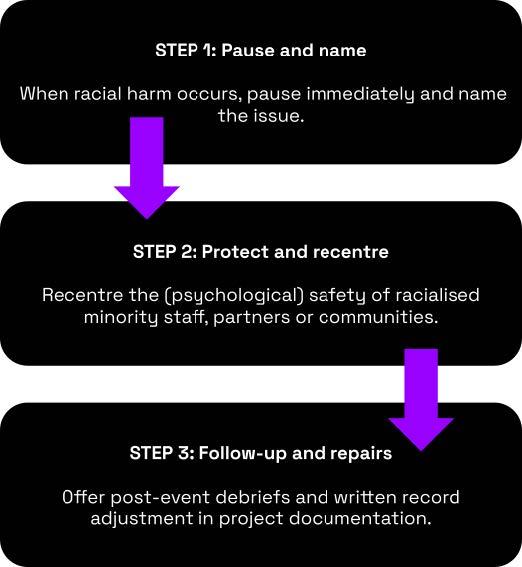
Simple flow chart showing 3 steps on how to intervene when racial harm occurs. Step 1: When racial harm occurs, pause immediately and name the issue. Step 2: Recentre the (psychological) safety of racialised minority staff, partners or communities. Step 3: Offer post-event debriefs and written record adjustment in project documentation.

Facilitating public engagement events, whether workshops, community advisory groups, panel discussions, or public consultations, is dynamic and can be unpredictable. Even in spaces designed with the best intentions, racism, racial harm, white defensiveness, or peer conflicts can happen.

When tension or harm occurs during a live session, facilitators often freeze, unsure of how to intervene without escalating the situation or making participants uncomfortable.

This guide supports you in intervening. It is not about punishing anyone or creating a hostile atmosphere; it is about care, safety, and rebalancing power so that racialised minority participants and staff are not left to carry the burden of harm.

Remember that imperfect intervention is always better than silence. When facilitators remain silent during moments of racial harm, it is often experienced as agreement or institutional indifference by minoritised participants.

Important warning

⚠️Never normalise racism

De-escalation scripts and harm-reduction protocols are designed for real-time safety and boundary-setting. They must never be used to normalise, quietly absorb, or accept racial abuse as "just part of public engagement."

Experiencing repeated racial harm, racial violence, hostility, or tone-policing causes real emotional exhaustion and somatic stress. Racial harm is an institutional failure and is not acceptable. When incidents cross the line to harassment or abuse, facilitators and staff have the full right to suspend activities, file formal grievances, and pursue legal or disciplinary action.

Guiding principle for live interventions

Before stepping into any live public engagement setting, keep these foundational principles in mind:

1. Centre the person experiencing racial harm

Prioritise the psychological safety and dignity of the person targeted or minoritised in the room, rather than protecting the comfort or reputation of the institution or the person who caused harm.

2. Interrupt promptly

Silence is often interpreted as institutional approval and indifference.

3. Separate de-escalation from safety enforcement

De-escalation applies to unexamined bias; hard stops apply to hostility or unlawful harassment.

4. Shared responsibility

Facilitators, especially those racialised as minorities, carry significant emotional labour. You have the right to set firm boundaries, pause sessions, or take a break to safeguard your own well-being. It is important to share the responsibility and to not leave it to racialised colleagues, community partners, or minoritised participants to "call out" harm or defend their own humanity.

Live intervention scenarios

Below are common live public engagement scenarios informed by real practitioner experiences, paired with scripts you can use and adapt immediately.

For each scenario, you will have 2 options of facilitation:

  • Option 1 is low-confrontation and tailored for junior or precariously employed facilitators.
     
  • Option 2 enforces direct boundaries. It is a formal, assertive hard stop for facilitators with seniority.

Scenario A: "What-about-ism" in focus groups

  • The situation: During a workshop on health equity, a participant interrupts a Global Majority contributor, arguing that focusing on race excludes white working-class struggles.
     
  • Why is it harmful? The specific concern about racial equity is diluted and invalidated, leaving the racialised participant isolated.

Possible responses to scenario A:

Option 1: 
"Thank you for raising class inequalities—they are deeply important. In today's session, we are specifically examining how race intersects with these systems. Let's return to the point raised by [Name] regarding racial barriers in health access."

Option 2: 
"We have explicitly established this session to focus on racial equity. Shifting the focus away from racial harm undermines the purpose of our agreed space. We will re-centre [Name]'s point now."

⚠️Backlash warning: Setting firm boundaries around scope may cause participants to accuse the team of being "divisive." Ensure co-facilitators are ready to support group management.

Scenario B: Invalidation of lived experience

  • The situation: A senior academic dismisses a community member's account of institutional racism as "anecdotal" and demands "rigorous statistical proof."
     
  • Why is it harmful? Demanding quantitative data to validate personal or community accounts of racism enforces epistemic injustice and academic gatekeeping. It delegitimises community expertise, treats systemic harm as mere "opinion," and creates an unequal hierarchy where only university-sanctioned metrics are granted authority. This invalidates minoritised contributors and protects the institution from accountability by setting unattainable evidential thresholds for lived realities.

Possible responses to scenario B:

Option 1: 
"In this project, community lived experience is recognised as expert evidence alongside quantitative data. Both are necessary to understand systemic barriers."

Option 2:
"Our framework explicitly rejects treating community expertise as secondary or 'subjective.' We treat lived experience accounts as valid empirical evidence for institutional change."

⚠️Backlash warning: Refusing to allow tone-policing or defending lived experience as empirical evidence may prompt defensive reactions, accusations of "bias," or claims that academic rigour is being compromised. Be prepared to re-anchor the discussion in agreed project research governance and trauma-informed ground rules.

Scenario C: Assumptions of (in)competence

  • The situation: During a public panel or Q&A, an audience member or fellow speaker expresses surprise at a racialised expert's credentials or authority, or makes patronising comments.
     
  • Why is it harmful? It undermines the authority, expertise, and dignity of racialised experts in front of an audience.

Possible responses to scenario C:

Option 1:
"To be clear, [Name] is leading this research because of their extensive expertise in [Field]. Let's make sure our questions focus directly on their findings."

Option 2: 
"That question seems to assume who holds knowledge in this space. In our project, community expertise and academic expertise hold equal importance."

⚠️Backlash warning: Correcting patronising comments or asserting a minoritised expert's authority publicly can trigger subtle defensiveness, passive resistance, or post-session complaints regarding "facilitator hostility". Ensure co-facilitators validate the speaker's standing immediately and log any audience pushback.

Scenario D: Explicit hostility or racist remarks from the audience

  • The situation: During a public event or open Q&A, an attendee makes explicitly racist, anti-immigrant, or hateful comments.
     
  • Why is it harmful? The space becomes unsafe for minoritised attendees and staff.

Possible responses to scenario D:

Option 1: 
"Our priority is to keep this space safe for everyone present. If you cannot engage respectfully with our ground rules, I will ask you to step out of this session."

Option 2: 
"I am stepping in as facilitator. That comment violates our ground rules. We do not permit discriminatory or hostile language in this space. I am pausing the session."

⚠️Backlash warning: Executing an immediate hard stop or removing a hostile attendee can trigger verbal escalation, claims of "censorship" or "violating free speech," or post-event complaints to university leadership. Alert campus security and venue staff beforehand, and complete a formal incident log immediately.

Scenario E: Senior leadership panic and political backlash

  • The situation: Following public pushback, social media controversy, or fear of a negative news headline, university leadership panics. Senior management pressures junior Public Engagement Professionals to suddenly "tone down," censor, or abandon co-created racially equitable public engagement activities mid-project.
     
  • Why is it harmful? Low-seniority practitioners are held to impossibly high institutional standards to deliver "massive culture change." Still, they are left completely exposed, unsupported, and expected to absorb public and community harm on their own.

Possible responses to scenario E:

Option 1: 
"I understand leadership's concern regarding external visibility. However, pulling back or censoring this activity midway breaks our ethical trust with community partners and causes serious institutional harm. Let's look at our institutional Public Sector Equality Duty commitments and agree on an executive communications strategy that shields staff from public exposure."

Option 2: 
"The burden of managing national political friction or institutional reputational risk is collective. If senior leadership wishes to modify this public engagement project, that decision and its rationale must be communicated directly by senior management to community partners, rather than expecting junior staff to absorb that fallout."

⚠️Backlash warning: Pushing back against executive pressure or demanding that senior management communicate cancellations directly can create institutional tension, career friction, or administrative isolation. Engage local trade union representatives and senior institutional backers to protect junior staff.

Scenario F: Performative gatekeeping and internal exclusion

  • The situation: During a project planning session, live panel, or team meeting, a majority practitioner who has built a career around "inclusive engagement" cornered the market on racial equity, but actively undermines, speaks over, or dismisses a racialised colleague.
     
  • Why is it harmful? Racial equity terminology is used for individual career advancement, while racialised minority staff are discriminated against, tokenised, or pushed out.

Possible responses to scenario F:

Option 1: 
"I want to pause us here. Racial Equity in public engagement is a collective practice, not an individual niche or career asset. [Colleague’s Name] brings critical expertise and lived experience to this topic, and we need to ensure their voice directly shapes this project's direction."

Option 2: 
"Doing racial equity work means taking it to heart in our daily interactions with colleagues, not just using it in grant proposals. Let's step back and ensure our internal team dynamics reflect the equity and respect we claim to practice publicly."

⚠️Backlash warning: Calling out internal gatekeeping or performative allyship in team settings can provoke defensive personal attacks, professional alienation, or accusations of "ruining team harmony". Maintain clear written records of team decisions and escalate recurring gatekeeping to department heads.

Scenario G: Defensive invalidation in meetings

  • The situation: During a project meeting or steering committee, a racialised participant or practitioner highlights structural barriers or historical institutional harm. A senior colleague responds defensively ("I feel that you are overly critical of our work”, "That wasn't my intention" or "We shouldn't bring politics into scientific work"), shifting the group's focus away from systemic harm toward managing the senior colleague's emotional distress.
     
  • Why is it an institutional failure? Defensive derailment centres white emotional comfort, weaponises professional norms to silence critical feedback, and forces racialised participants into uncompensated emotional labour while structural inequities remain unaddressed.

Strategic responses to scenario G:

Option 1:
"We understand that everyone means well, but we need to focus on the real structural issues at hand. Just because someone didn't intend to cause harm doesn't change the effect on our partners or the project. Let's get back to discussing the specific procedural problem we need to fix.

Option 2: 
"Decentring institutional harm by labelling it 'political' or 'aggressive' prevents us from doing rigorous work. Scientific institutions and public engagement don't exist outside history. Addressing structural exclusion is a matter of academic integrity and institutional compliance, not personal conflict. Highlighting institutional failures in this room requires significant energy. Rather than expecting our community contributor to rephrase their lived experience for our comfort, let's step up and focus on how our department will address the issue raised."

⚠️Backlash warning: Refusing to manage or prioritise a senior colleague's emotional distress can lead to claims of "unprofessionalism" or formal grievances. Re-anchor all responses in institutional PSED, REF Research Culture, and Health & Safety compliance duties.

Scenario H: Defensive invalidation in online meetings

  • The situation: During a hybrid consultation, participants in the Zoom chat leave comments regarding a community presenter's background, while online raised hands are repeatedly ignored in favour of in-person attendees.
     
  • Why is it an institutional failure? When chat goes unmoderated or virtual raised hands are ignored, it signals that online contributors matter less. This often affects community partners who join remotely because of travel, health, or caregiving needs. Treating their participation as an afterthought reinforces the idea that digital presence is just for show and lets institutions keep power instead of sharing it.

Strategic responses to scenario H:

Option 1:
"A reminder to all participants that our chat moderation guidelines apply equally online and in-person. I am pausing in-person comments to take two questions directly from our online Zoom participants."

Option 2:
"We have disabled the chat temporarily due to comments that violate our community ground rules. Online contributors hold equal standing in this project, and we will not proceed until chat etiquette is restored."

⚠️Backlash warning: Disabling chat or correcting online behaviour may lead to attendees leaving the call or complaining of "censorship." Document the incident in your event post-debrief.

From de-escalation to formal escalation and legal action

Not all live harm can or should be de-escalated through conversation. De-escalation fits defensiveness or unexamined bias. It is not appropriate for hate speech, harassment, targeted abuse, or physical threats.
When a situation crosses the boundary from conversational friction into unlawful harm, facilitators must shift immediately from de-escalation to formal escalation.
You must shift to formal escalation if an individual:
  • Uses explicit racial slurs, hateful tropes, or discriminatory language.
  • Engages in targeted harassment, intimidation, or threats against staff, speakers, or attendees.
  • Refuses to respect firm facilitation boundaries after being asked to stop.
  • Displays behaviour that violates the Equality Act 2010 (e.g., unlawful harassment based on race).
     
Harm reduction requires institutional accountability. Following a severe incident, the project lead or institution must pursue the following formal routes:
  • Formal institutional reporting: File an official incident report through your university’s disciplinary mechanisms.
     
  • Statutory and legal protections: Under the UK Equality Act 2010 (and the Worker Protection Act 2023), higher education institutions must protect employees and third parties from foreseeable harassment and discriminatory environments.
     
  • Union involvement: Staff targeted by racial harassment or institutional backlash should contact their trade union representative for legal advice and casework support.
     
  • Reporting criminal offences: Explicit hate speech, physical threats, or severe harassment constitute criminal hate incidents under UK law. The institution must support impacted staff or community members if they choose to report the incident to the police.

If in doubt, consult our Decision Questionnaire below.

Decision Questionnaire

Step 1: Check for immediate danger or abuse

Ask yourself: Is anyone using explicit racial slurs, threatening physical safety, or making targeted, hateful attacks?

Post-event care and repair

Harm reduction does not end when the public event finishes. What happens after a high-friction session is critical for building long-term trust.

Peer debriefing for facilitators and staff

  • Take direct accountability: Contact promptly to participants who experienced racism, racial harm, or tone-policing. The purpose of this communication is to acknowledge the facilitation failure, state what actions you are taking to fix it, and offer support, not to ask the participant to educate you, explain their pain, or solve the problem.
     
  • Relieve all obligation to respond: Explicitly state that the participant is under no pressure or expectation to reply. Asking someone who has experienced harm to provide feedback or suggest solutions creates uncompensated emotional labour.
     
  • Documenting patterns for institutional change: Keep a written record of what happened and share it within the team. Do not ask people to repeat incidents multiple times. Use recording as evidence to advocate for better pre-event briefings, higher community compensation, or mandatory facilitation training across your department.
     
  • Protect minoritised facilitators: Ensure racialised minority colleagues are not expected to write up incident reports or lead debriefs if they were directly targeted or emotionally exhausted.
Example of follow-up message:
Dear Rowan,
Thank you for attending today's Community Dialogue Session. I am writing to acknowledge what happened during the racial equity discussion.
During the session, an inappropriate comment was made that detracted from the important conversation we were having. Our facilitation fell short, and we did not intervene as swiftly or effectively as we should to protect the space and support you. I am deeply sorry for the harm and discomfort this caused.
We take full responsibility for ensuring our engagement spaces are safe and equitable. To address this, our team is taking these immediate steps:
  • We have logged this incident formally in our project review.
  • We are adjusting our facilitation protocol and co-facilitator roles for future sessions to ensure we can intervene immediately.
  • We have addressed the violation with senior project leads, removed the individual involved from attending future sessions in this project series, and informed them that they may not attend future projects without first reviewing and agreeing to our strict code of conduct.
Your well-being and trust matter most. We want to offer support in whatever way feels right to you:
  • Your contribution: If you wish to adjust, retract, or clarify how we use your contributions from today’s session in the project, we will fully honour your preferences.
  • Independent contact: If you would prefer to speak with someone outside the facilitation team with extensive experience in racial equity, you can connect with Alex Colman at alex.colman@email.com.
  • Conversation (if you'd like): If you want to share anything further, we are here to listen, but please don't feel any obligation.
Please know you do not need to reply to this email. We share this so you know we hold ourselves accountable and are actively improving our practice.
Warm regards,
Charlie Thompson
Facilitator, Public Engagement Team

Where next

Racial Equity Resources

Exploring Racially Equitable Choices Through Case Studies

Please note: This page is currently in development. The content is in draft form and may change before the resource is formally launched. Purpose: Contrast extractive institutional engagement with racially [...]
Racial Equity Resources

Words Matter: A Language Guide for Centring Racial Equity

Please note: This page is currently in development. The content is in draft form and may change before the resource is formally launched. The words we choose when discussing racial [...]

Contact us

Want to discuss a new idea, ask a question or provide some feedback? Get in touch with the team.
Contact us

Join our community

NCCPE's Public Engagement Professional Network is for those doing or supporting public and community engagement.
Find out more!

NCCPE Services

We help universities to better support, embed and recognise meaningful public engagement.
Explore our services

Sign up to our newsletter

Subscribe to our mailing list to receive the latest engagement news, events and opportunities from the NCCPE.

Please see our privacy notice for information on how your data will be processed.

Sign up
University of the West of England: logo
University of Bristol logo
Home

Copyright 2026 National Co-ordinating Centre for Public Engagement
Funded by UK Research and Innovation, the devolved Higher Education funding bodies, and Wellcome

Website by Big Blue Door

Utilities

  • Privacy Policy
  • Accessibility
  • Cookie Policy