
Creating Safer Institutions: Protection Policies
Please note: This page is currently in development. The content is in draft form and may change before the resource is formally launched.
Purpose: Establish clear institutional protections before, during, and after any public exposure or backlash. Instead of expecting individuals to simply be resilient, it makes care and collective protection a shared, enforceable responsibility for the whole institution.
Institutional duty of care and workload protection
When public engagement shifts from surface-level diversity to real power-sharing and anti-racist action, being visible in public spaces can bring real risks. Online hate, media storms, doxxing, and targeted harassment often land hardest on minoritised colleagues, staff in insecure jobs, women, disabled people, and LGBTQIA+ workers. These individuals often face public hostility while also feeling isolated within their own institutions.
Institutions often benefit from the public-facing racial equity work of their staff, gaining both reputation and funding. To meet their legal responsibilities under Health & Safety and equality laws, universities need to treat digital hate and public backlash as real workplace hazards, not just personal issues for individuals to manage alone.
Understanding Institutional Workload & Protection Levers
|
|---|
Recognised Workload Tariff Framework (Yelin & Clancy Model)
Racial equity leadership and crisis response should never be treated as unpaid extras or voluntary emotional labour. Line managers need to set aside clear, recognised hours for this work, and make sure it counts towards promotion and appraisal.
- Leading high-risk equity projects (50–100 hours/year): This includes designing anti-racist projects, managing community partnerships, and handling public risks. These hours should be formally recognised in annual appraisals and promotion processes.
- Crisis management and backlash navigation (30–50 hours/year): These hours are set aside for times when there is active media attention, doxxing, or harassment, so staff can focus on safety and getting the right support from the institution.
- Mentoring minoritised staff and students (20–30 hours/year): This recognises the time spent supporting colleagues and students, helping them navigate the institution, and providing pastoral care, so this important work is not left unpaid or invisible.
- Equity governance and policy drafting (20–40 hours/year): This includes time spent on committees, working on legal agreements, and advocating for change within the institution.
Your practice: Reviewing pre-launch workload and protection
Before you launch a high-visibility project, take a moment to reflect:
- Is your racial equity or community crisis work explicitly tariffed in your annual Workload Allocation Model (WAM), or is it expected as uncompensated "citizenship" labour?
- Who in your project team carries the highest public visibility, and are they protected by permanent contracts or exposed by precarious/temporary employment?
- Does your department treat digital harassment as a formal Health & Safety incident requiring line management action, or as an individual's private social media issue?
Four pillars of trauma-informed public engagement
Trauma-informed practice helps make sure that racial equity work can continue over the long term, without costing practitioners or community partners their health and wellbeing.
Your practice: Reviewing design against trauma-informed pillars
Reflect on these questions using the four pillars below:
- Have you held a clear, "no-surprises" discussion with community partners and junior staff about potential public pushback before public launch?
- Is post-event debriefing built into your official project timeline as paid working hours, or do staff disperse immediately after high-friction sessions without processing?
- Do you schedule post-event recovery time into your grant milestones, or do staff treat rest as something they must squeeze into their personal weekends?
1. Safety and transparency
Communicate clearly and openly about what to expect, what the risks are, and how the institution will support you, before any work begins.
2. Humility and shared power
Move away from top-down authority and value lived experience just as much as academic research.
3. Peer support and debriefing
Make it normal to have debriefs after events, offer informal peer support, and process challenging sessions together.
4. Mandatory rest and recovery
Treat rest as a basic workplace right, not something extra or optional.
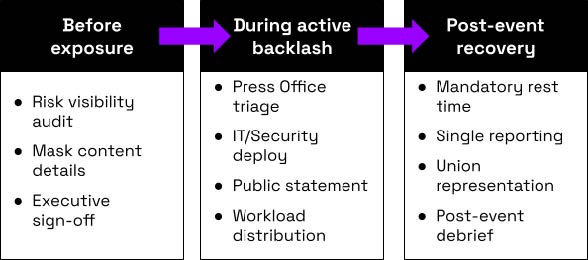
This protocol activates mandatory institutional protection mechanisms across three operational phases: before public exposure, during active backlash, and post-event recovery.
Duty of care for non-employed partners, freelancers and public contributors
Independent public contributors, lived-experience advisers, community partners, and self-employed facilitators can face significant backlash and safety risks during high-visibility racial equity projects. Unlike employees, they may not have access to protections like line management support, internal casework, or trade union representation.
Institutions have both an ethical and legal duty of care to non-employed partners involved in university-commissioned or co-produced projects. Project leads and commissioning departments should ensure the following four protections are in place for non-employees:
- Every project should designate a permanent university staff member (outside the immediate project delivery team) as an independent escalation contact. This gives community partners a clear route to report harassment, safety concerns, or institutional challenges.
- If independent contributors or community partners experience digital hate, doxxing, or harassment as a result of their project participation, the institution should provide fast-track access to funded counselling, mental health stipends, or peer support services.
- Non-employed contributors have the right to request anonymity or pseudonymity on public press releases, project websites, and promotional materials. University Press Offices should extend media support to community partners, ensuring journalists or external actors do not contact partners directly.
- If severe harassment, physical threats, or doxxing occur as a result of co-produced university work, university legal advisers and Campus Security should extend protective guidance and police liaison support to affected non-employed community partners.
⚠️If central legal or finance teams are concerned about extending wellbeing funds or legal advice to non-employees due to liability restrictions, remind them of the institution's duty of care under third-party risk management and the Worker Protection Act 2023. This can help reframe the conversation and support inclusive practice. |
|---|