Blog
quality practice

Meet the PhD Participatory Research Network

updated on 21 Jul 2026
4 minutes

Written by Emma Hayashibara, a PhD candidate at Queen Mary University of London. This blog shares Emma's experiences of creating a network for PhD students interested in participatory research.  
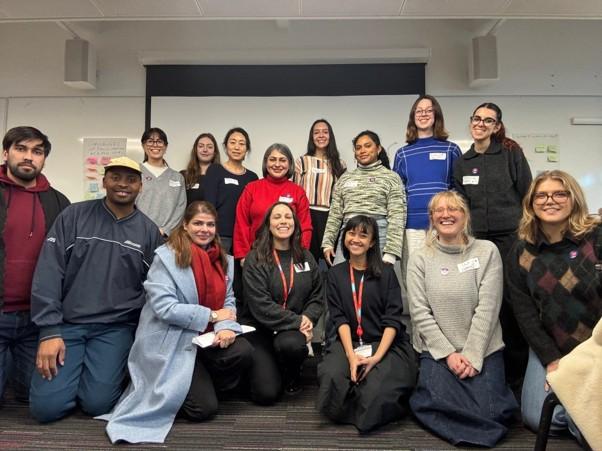
Two conference delegates chatting together and smiling

I’m Emma Hayashibara, a PhD candidate at Queen Mary University of London. In this blog, I reflect on why we created the PhD Participatory Research Network, what we’ve learned along the way, and why supportive spaces for PhD students are important.
 

Many PhD students feel passionate about participatory approaches and recognise the importance of embedding these approaches in research but often don’t know where to begin. We attend training courses and academic talks to try to understand how to embed these approaches, but many of these sessions are not tailored to our needs or level of experience. This is especially the case when examples focus on large-scale projects with substantial funding and well-established, large research teams.


As PhD students, we are still training as researchers and often working under tight time and funding constraints. Unlike large, well-funded projects, there is an expectation to balance participatory approaches with the requirement to carry out our own individual research and produce a thesis, which can make it especially difficult to fully embed these approaches.

How the PhD Participatory Network began

The PhD Participatory Research Network launched in November 2025 with a passing thought: what if there was a community of PhD students who could come together to make participatory research seem more manageable, and create a supportive space to navigate it together?

Thanks to the support from the London Interdisciplinary Social Science Training Partnership (LISS DTP) and committee members, Cheyenne Contreras, Alexandria Bartley, and Samuel Yosef, we made it happen. Since then, we have hosted in-person, hybrid, and online sessions focused on different participatory research processes and themes. We have been incredibly lucky to learn from inspiring facilitators and guest speakers, but the most valuable part has been connecting with other PhD students from across London and beyond who are passionate about participatory research.

Aims of the Network

From the beginning, we wanted the network to meet the needs of PhD students. We aim to balance our sessions by having clear themes and agendas, while also creating a space for people to bring their own challenges and experiences into our sessions. Many of our sessions combine guest speakers or workshops with structured opportunity for reflection on our own research. We often finish by collectively exploring what makes a particular aspect of participatory research challenging within a PhD, and what kind of support, resources, or changes might help address these challenges.

Throughout our sessions, we have come to realise that many of us face similar barriers and challenges: uncertainty about where to start, concerns about feasibility, burnout, imposter syndrome, emotional labour, and feelings of guilt associated with not feeling like we were doing participatory research “well enough”. Having a space to connect with others facing similar challenges has helped create a sense that we are not doing this alone. One of the biggest learning curves has been recognising that participatory research at a PhD level might not always look like large, fully funded participatory projects. Instead, our network has reflected on what participatory research looks like within PhD constraints, and how we can meaningfully and realistically embed these values.

There are increasing conversations about the importance of participatory approaches, but less discussions about how PhD students can actually do this in practice. In response to these challenges, we are bringing together insights and discussions from our sessions to develop a toolkit by PhD students, for PhD students, with the hope to support future PhD students navigate similar questions, such as “Where do I begin?”, “How do I actually do this?”. 

Impact of the Network

For me, creating this network has been a form of activism: encouraging PhD students to believe that these approaches are achievable and meaningful, and striving towards a future where participatory approaches are considered a normal part of PhD research, rather than something that is only for large, well-funded research. It has also been a way of demonstrating to institutions that there is a real push from PhD students to undertake participatory research, and that greater support, training, and opportunities are needed to make this possible. We must remember that PhD researchers are the next generation of researchers, and our experiences and challenges should be made more visible, rather than navigating this silently and alone.

We also hope to encourage other PhD students across the globe to create similar communities and support networks. We believe in the value of creating safe spaces where PhD students can learn from one another, share experiences, and collectively navigate the realities of participatory research.

Get involved!

We’d love to hear from others navigating participatory research during a PhD. What barriers have you experienced, and what kind of support or communities have helped you?

Any PhD student at any institution is welcome to join our network, regardless of your experience with participatory research: