Reflections on Trialing the Civic Capabilities Framework
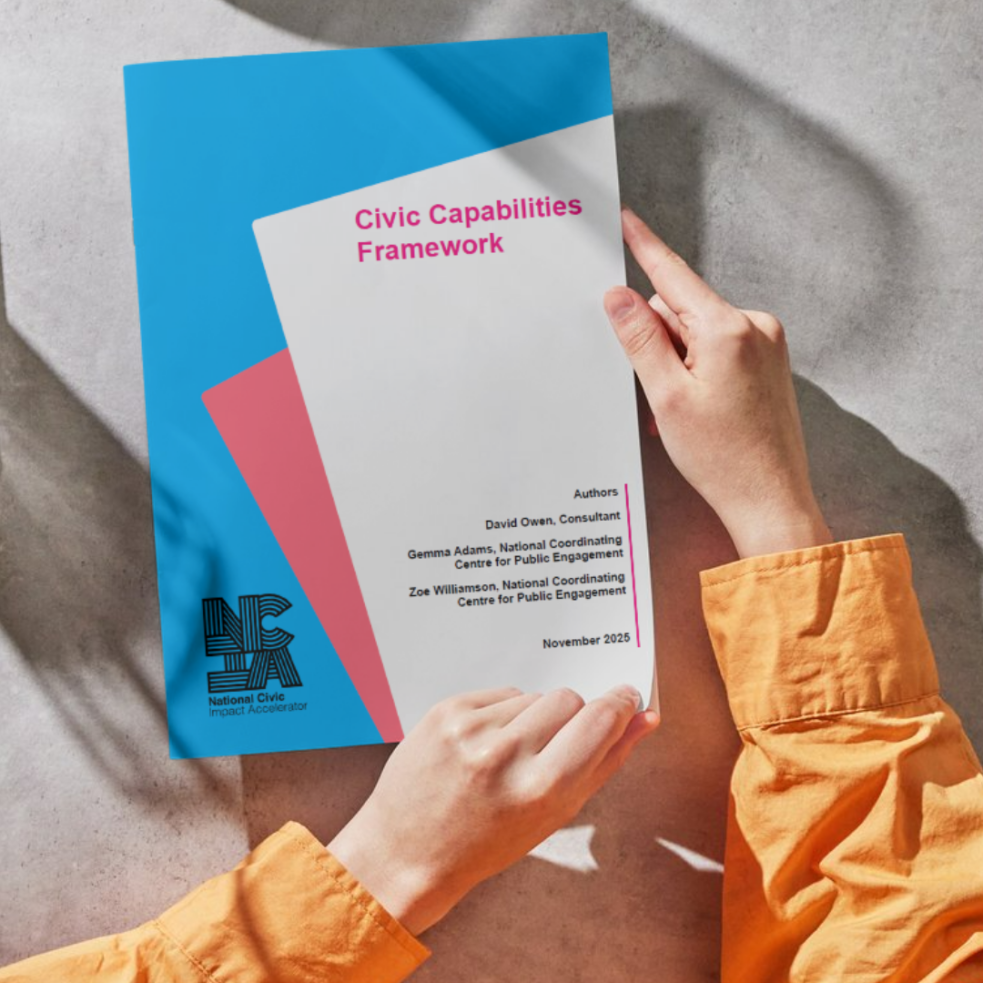
When we invited colleagues from across the Public Engagement Professionals and Civic University Network to spend some time exploring the Civic Capabilities Framework, we weren’t sure quite what we would discuss. We hoped that attendees would bring their knowledge and experience of supporting civic and public engagement work, and a curiosity about whether this new resource might help make some of that work more visible, valued, and supported.
What followed was a rich conversation about the nature of this work: the emotional labour, relationship‑building, behind‑the‑scenes influencing, and the sheer variety and complexity of it all. These themes resonated with public engagement professionals and those working directly on the civic agenda, a helpful reminder that while our job titles vary, the underlying principles and approaches often look and feel remarkably similar.
By Zoe Williamson, David Owen, Gemma Adams & Hannah Moss
A shared language for work that often goes unnamed
We began the event by inviting attendees to describe their roles in a single word or phrase. The responses were instantly familiar to anyone working in engagement: “connector”, “facilitator”, “listener”, “translator”, “mediator”, “many hats,” and “plate‑balancer.” These are the roles engagement professionals often occupy, the glue between researchers and communities, the bridge between institutional agendas and lived experience, the person who holds the emotional climate of a project steady.
When we later explored the framework, one thing that people reported was that it helped them articulate what they do. Attendees shared this could be useful for their own reflection and development, or for managing upwards and talking with senior leaders about what it is they do.
In a sector that has long struggled to recognise “third space” labour, the framework provided a place for that work to be recognised.
Seeing our own practice
In the session we trailed a self-assessment activity, participants explored one of the three domains, Knowledge, Capabilities, or Attributes, and identified where they felt they sat developmentally, plotting it on a coaching wheel. The exercise revealed that we had developed the domains with a good degree of insight into the messiness and complexities of these roles.
Some attendees found themselves at different points of the spectrum for different domains, for example, they were experienced at relationship‑building, advocacy, or facilitation, yet still emerging in evaluation, governance, or institutional navigation. Others realised how much their capability had quietly deepened through years of on‑the‑ground engagement: the ability to hold space for others, to read group dynamics, to sense when a conversation is stuck and gently unlock it.
It was noted that some domains were overly broad and could be expanded. Covering vast areas of expertise like ‘Knowledge Mobilisation’ in one sentence is not easy.
Conditions that make engagement work possible
A central theme that emerged, was the importance of institutional conditions. The work relies heavily on emotional intelligence, trust‑building, and deep listening. Attendees spoke openly about the emotional labour inherent in engagement work: absorbing frustration, managing expectations, navigating cultural difference, and caring for people as well as projects.
This sparked vital reflections on wellbeing and sustainability. The idea of “resilience” can be framed in a challenging way; several attendees noted that they wanted a definition rooted in self‑awareness and the ability to set boundaries, not one that inadvertently endorses burnout. For engagement professionals who are often stretched thin across multiple programmes, this nuance matters.
Another theme was time and how building knowledge of place, nurturing relationships, and understanding institutional culture require patience and continuity. This is something that, in an often-under-resourced field, engagement professionals are not always able to provide. The framework helped surface these realities and situate them within professional capability, rather than treating them as personal shortcomings.
A living resource
What this collective exploration made clear is that the Civic Capabilities Framework is not a static product. It’s a reflective tool that provides a shared language and starts conversations. It has the potential to strengthen the professional identity of public engagement and civic practitioners alike, by recognising the depth, nuance, and humanity of their work.
More than anything, the session affirmed the value of coming together across job titles and institutional contexts to reflect on what we do. Public engagement and civic work thrive on relationships, mutual learning, and collective sense‑making, and the framework seems poised to support that.
The tool is at the beginning of its journey, and as its used and tested we encourage you to adapt the framework. We’ll continue listening, learning, and developing it alongside you. We’re already thinking about what this resource could look like for Public Engagement Professionals and Engaged Academics.