BioInspire: Inclusive Schools Engagement
Facilitating engagement with schools and young people in Cambridgeshire to tackle ‘real world’ challenges in improving lifelong health.
Snapshot
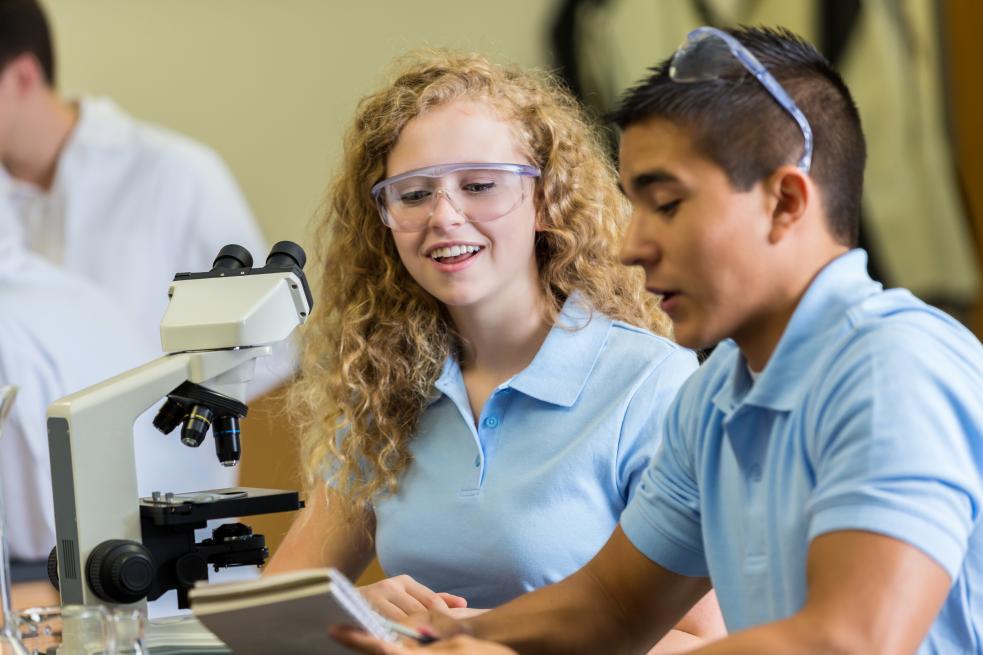
BioInspire focuses on widening and resourcing access for schools based in Cambridgeshire postcodes of low social mobility to engage with research in improving lifelong health. Methods include youth conferences, in-school workshops, lab-based work experience placements and online educational resources. Now running for five years, BioInspire has yielded significant increases in target audiences engaging with the programme: going from 20% target postcodes in 2021 to 74% in 2025. Young people, teachers and researchers based at the Institute have collectively gained significant benefits from being involved in the programme.
BioInspire is a programme based out of the Babraham Institute in Cambridge. It receives strategic funding from the Biotechnology and Biological Sciences Research Council (BBSRC).
Background and Purpose
The BioInspire programme was launched in 2020 to extend the Babraham Institute’s public engagement in Cambridgeshire postcodes with low social mobility and where science engagement and enrichment were low. BioInspire emerged after the public engagement team at the Babraham reflected on who wasn’t being reached by their current programming, and how a widened programme could be shaped and delivered in the region. Traditionally, Babraham’s public engagement focused on schools near itself in Cambridgeshire with “high science capital”, who already had the privilege of multiple public engagement opportunities from Babraham. The public engagement team also recognised that short-term bursts of public engagement weren’t efficient at supporting and building long-term trust and uptake, especially within underrepresented communities.
Using the Institute’s main focus on understanding human biology and improving lifelong health, BioInspire aims to build students’ awareness about the molecular processes involved in ageing, beyond their typical curriculum. The programme also creates a mechanism to gather the perspectives of young people from Cambridgeshire about the research produced within the Institute. It builds trust with younger audiences and platforms their voices regarding what they want to see in future research.
Approach to engagement
The mechanism of engagement in BioInspire consists of actively reaching out to and building partnerships with schools to deliver bespoke sessions on school premises and inviting these schools to visit the Institute. The Institute initiates the conversation and works with a school to find out what best suits their needs and how the BioInspire programme can align with this. The Institute also covers the cost of transport and activity delivery. The intention is to remove barriers to a school’s access to the programme.
Broadly, the programme involves a mix of in-person workshops, online direct engagement (talking to researchers), and some student-led activity, including students being equipped to facilitate public engagement for peers in their own schools. As a result of the programme, students are able to learn about, contribute to, and gain inspiration from Babraham’s work.
Additionally, target schools now have the option to be sponsored to take part in the Norfolk-based Youth Science, Technology, Engineering, Mathematics, and Medicine (STEMM) award. BioInspire covers the costs for schools to sign up and for up to 20 students per school per year to take part. This add-on supports student portfolios, and the award is recognised by the Universities and Colleges Admissions Service (UCAS).
BioInspire has two evaluation streams: a quantitative metric approach measuring what proportion of total public engagement audiences, per year, fall into target postcodes; and qualitative narratives from students, schools, and researchers at the Institute. The latter stream includes baseline and endpoint surveys filled in by students, and narrative feedback from some teachers as well as from researchers at the Institute.
Outcomes and impact
The programme has recorded an upward trajectory in its intended outcomes since it started: up to 74% of the Institute’s engaged public audiences are now from target areas, a rapid increase from 20% in 2021. The Institute also recorded an increase in attendance at their Schools’ Day, which is an annual event they hold where secondary and sixth-form students complete hands-on lab projects, guided by Institute researchers. The number of students from target zones attending Schools’ Day was 0.4% around 2020, and as of 2025 it was over 50%. Survey results also indicate that students enjoyed working as a cohort and see the programme as “more than just extra schoolwork”. Additionally, the Institute has at least one case of a former BioInspire participant later returning for a Babraham-based undergrad placement.
A significant outcome for the Institute is the introduction of support for public engagement within its core grants for researchers. For researchers, BioInspire has resulted in more training and support mechanisms being set up on how to participate in public engagement.
Finding ways to enable schools to take part was a challenge for the BioInspire team. It took significant capacity to individually phone schools to start conversations. Another challenge was how to responsibly and sensitively map a target audience, and eventually the postcode method was found to be the most appropriate measure to prioritise areas that had fewer opportunities for people to engage with science.
Legacy
The team have trialed an exclusively online version of the BioInspire programme and aim to make the online offer a regular feature of the programme, supporting a cohort of up to 20 students recruited nationally in addition to students from local postcodes.
The team also hopes to find ways to reduce the administrative burden on teachers who support this programme on top of their other responsibilities. They aim to produce a suitably scaled-down version of the programme which can be directly implemented by teachers themselves.
Researchers at the Institute would also like to work with older people. They believe sparking multigenerational family conversations will support their overall goal to facilitate learning spaces for people to share their feelings, hopes, and doubts about research and science. At the same time these community conversations will continue to platform public voices which in turn will help researchers at the Institute to shape their future work.
Acknowledgements
- Council Remit: Biotechnology and Biological Sciences Research Council (BBSRC).
- University Affiliation: Babraham Institute
This case study was written by NCCPE Associate Furaha Asani in collaboration with UKRI.